Safety shoes for work are one of the most widely required types of personal protective equipment (PPE) in Irish workplaces, protecting employees from crushing, puncture and slip hazards on construction sites, factory floors, warehouses and food production lines.
However, the range of styles, toe caps and certification markings available, along with the 2022 update to EN ISO 20345, means a shoe can carry a valid rating and still be wrong for the task.
In this article, we outline how employers can find the best safety shoes for work, covering the legal duties involved, the hazards and standards to check, and how fit, trials and replacement affect long-term value.
Why safety shoes for work matter for Irish employers
Under Regulation 62 of the Safety, Health and Welfare at Work (General Application) Regulations 2007 (S.I. No. 299/2007), employers must provide PPE, including safety shoes for work, wherever a risk cannot be avoided or sufficiently limited by other means. Section 8(5) of the Safety, Health and Welfare at Work Act 2005 also requires PPE to be free of charge.
Employers must also assess the risk before choosing footwear, consult employees and make sure each pair fits the wearer.
Safety footwear is the final layer in a wider hierarchy of controls, after measures such as well-maintained floors, prompt spill clean-up and pedestrian routes kept apart from forklifts.
Matching safety shoes for work to workplace hazards
Each protective feature on a safety shoe answers a specific risk, so the hazard assessment should always come before any product choice.
Common foot hazards in the workplace
The most common hazards that safety shoes for work address include:
- Falling objects and heavy loads (protective toe cap)
- Nails and sharp debris underfoot (penetration-resistant midsole)
- Wet or greasy floors (slip-resistant outsole)
- Rain, mud and cold (water-resistant uppers and insulation)
- Static near electronics or flammable atmospheres (antistatic or ESD footwear)
- Fuels, oils and chemicals (resistant outsoles)
- Hot surfaces (heat-resistant outsole)
Assessing tasks before specifying safety shoes for work
Buyers should also consider whether work is indoors or outdoors, the surfaces underfoot, time spent standing, and whether the role involves kneeling, ladders or driving.
One site may need several specifications, such as easy-clean, slip-resistant shoes on a wet production floor and water-resistant, puncture-resistant footwear for deliveries in the yard.
Understanding the standards behind safety shoes for work
Safety footwear sold in Ireland should carry a CE mark and a marking to the relevant EN ISO standard, which tells buyers exactly what the shoe has been tested to withstand.
Safety, protective and occupational footwear
Three related standards are often confused:
- EN ISO 20345 covers safety footwear, with a toe cap tested to 200 joules of impact and 15 kN of compression
- EN ISO 20346 covers protective footwear, with a toe cap tested to a lower 100 joules
- EN ISO 20347 covers occupational footwear, which has no protective toe cap
Footwear marked only to EN ISO 20347 is not safety footwear and should not be issued where a crushing risk has been identified.
Safety classes and markings at a glance
SB is the basic class; S1 to S3 add features such as antistatic properties, water-resistant uppers and penetration resistance, and S4 and S5 cover rubber or polymer footwear such as wellingtons. The 2022 revision added S6 and S7 for waterproof versions of S2 and S3.
The update also introduced PS and PL for non-metal puncture-resistant inserts (P now means a metal insert) and replaced WRU with WPA for water-resistant uppers. Footwear certified to the 2011 version stays valid until its certificate expires.
Slip resistance under EN ISO 20345:2022
Under the 2022 standard, all safety footwear passes a baseline slip test, and the optional SR marking shows it has also passed a tougher test on glycerine-contaminated ceramic tile. SRA, SRB and SRC no longer appear on newly certified footwear.
The Health and Safety Authority (HSA) notes that slip resistance comes from the sole and tread. Close-packed treads suit fluids, open treads suit loose solids, and footwear should be trialled on the actual working surface.

Choosing the right style and materials
Each style involves a trade-off between protection, weight and practicality:
- Safety shoes: light and flexible for indoor work and driving, with no ankle support
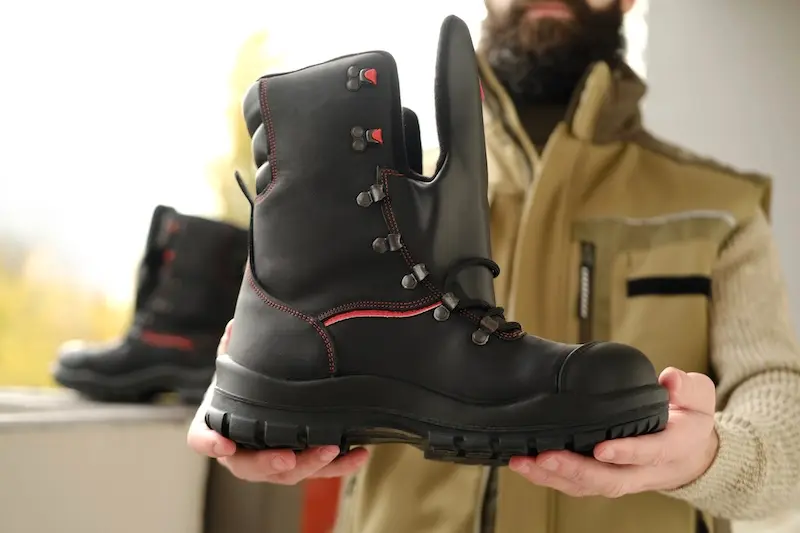
- Safety boots: ankle support on uneven ground and outdoor sites, though heavier
- Safety trainers: lightweight for lower-risk roles, though less hard-wearing
- Slip-on shoes and clogs: quick to change and easy to clean, suiting food and healthcare
- Rigger boots and wellingtons: suited to wet, muddy and washdown environments
Toe caps and midsoles
Steel toe caps are proven and cost-effective but heavier, and they set off metal detectors. Composite toe caps are lighter and non-conductive, while aluminium sits between the two. All three must pass the same 200-joule test under EN ISO 20345.
Steel midsoles (P) give dependable puncture protection, while textile inserts (PS or PL) are lighter and more flexible over a long shift.
Specialist features to check
Depending on the risk assessment, buyers may also need antistatic (A) or ESD footwear, a heat-resistant outsole (HRO), cold or heat insulation (CI or HI), ladder grip (LG) or metatarsal protection (M).
A higher specification is not automatically better, since extra protection adds weight, stiffness and heat.
Fit, comfort and trials for safety shoes for work
Uncomfortable safety shoes are often swapped for personal trainers or worn loosely, so fit directly affects whether they protect the wearer at all.
Getting the right fit from safety shoes for work
Buyers should check length, width and depth, allowing around 1 cm beyond the longest toe with no slipping at the heel. Employees should try footwear on with work socks, ideally later in the day, and walk, crouch and climb before a size is confirmed.
Women should be offered footwear built on women’s lasts, and removable insoles help accommodate orthotics or known foot conditions.
Running a workforce footwear trial
For larger teams, a structured trial should:
- Include wearers from each role and area of the site
- Run in real working conditions for an agreed period
- Gather feedback at set check-in points
- Record the process and the final decision
Trials also help employers meet their duty to consult employees on PPE selection.
Replacing safety shoes for work and managing cost
Inspection and replacement
Regulation 66 requires PPE to be kept in good working order and replaced where necessary. Safety shoes for work should be replaced when treads are worn smooth, a toe cap becomes exposed, soles split or come away from the upper, or a shoe has absorbed a heavy impact.
There is no fixed lifespan, since wear depends on the task and surface, so regular checks are more reliable than a calendar-based cycle.
Looking beyond the unit price
The lowest unit price rarely delivers the lowest overall cost. Durable, comfortable footwear lasts longer and is worn correctly, while a supplier holding a full size range avoids delays when equipping new starters.
A supplier who can explain markings also helps employers avoid buying unsuitable footwear, which is often a greater saving than a lower price per pair.
Source safety shoes for work from Ark Safety
Finding the best safety shoes for work means matching protection, fit and comfort to each role, backed by a supplier that keeps sizes in stock and can advise on the markings that matter.
We supply a comprehensive range of safety footwear, including safety shoes, safety boots, safety trainers, slip-on shoes, safety clogs, rigger and dealer boots, ESD footwear, women’s safety shoes and safety insoles, from leading brands including U-Power, Cofra, Beeswift, Dunlop, Portwest, Sika, Mascot and DeltaPlus.
Why businesses across Ireland choose us:
- Wide range of quality, compliant safety footwear for different hazards and roles
- Expert guidance on standards, markings and specifications
- 95% stock availability on stocked items
- Orders before 4pm are dispatched for next-day delivery
- Personalised service from an experienced team
- Competitive pricing designed for genuine long-term value
From construction and manufacturing to food processing, warehousing and facilities management, we help businesses across Ireland source safety shoes for work that suit their people and their hazards. Get in touch with our team today to find the right safety footwear for your workforce!
Safety shoes for work FAQs
Q: Do employers have to provide safety shoes for work in Ireland?
A: Yes, where a risk assessment identifies a foot hazard that cannot be controlled by other means. Regulation 62 of the General Application Regulations 2007 requires suitable PPE, which must be provided free of charge.
Q: What is the difference between safety, protective and occupational footwear?
A: Safety footwear is certified to EN ISO 20345 and has a toe cap tested to 200 joules. Protective footwear (EN ISO 20346) has a toe cap tested to 100 joules, while occupational footwear (EN ISO 20347) has no protective toe cap.
Q: What does SR mean on safety shoes?
A: Under EN ISO 20345:2022, SR shows the footwear passed an additional slip test on glycerine-contaminated ceramic tile. It replaces SRA, SRB and SRC on newly certified footwear.
Q: Are composite toe caps as safe as steel toe caps?
A: Both must meet the same 200-joule impact test under EN ISO 20345. The differences lie in weight, thermal and electrical conductivity, and whether the shoe will trigger a metal detector.
Q: How should safety shoes for work fit?
A: Allow around 1 cm beyond the longest toe, enough width that the foot is not squeezed, and no slipping at the heel, tested with work socks.
Q: How often should safety shoes for work be replaced?
A: There is no fixed interval. Safety shoes should be replaced when the tread is worn smooth, the toe cap is exposed, the sole splits or separates, or the shoe has absorbed a heavy impact.
Q: Does Ark Safety supply safety shoes for work with fast delivery?
A: Yes. We supply a wide range of safety shoes, boots, trainers and specialist footwear from leading brands, with 95% stock availability on stocked items and next-day delivery on orders placed before 4pm.